

Grant deed notarization in California is the formal process a notary uses to verify a grantor’s identity and witness their acknowledgment on a grant deed so the county recorder will accept it. This grant deed notarization guide shows you exactly what to prepare, how the signing works, and how Quickie Mobile Notary in Van Nuys helps you record cleanly the first time.
Quick Answer
In California, a grant deed must be signed by the grantor and acknowledged by a commissioned notary. We come to you at 15700 1/2 Vanowen St in Van Nuys—or anywhere in Los Angeles—verify valid ID, complete the California acknowledgment, capture a required thumbprint, and help you avoid county recording rejections.
At a Glance
A grant deed transfers real property. Recording requires a complete document, in-person acknowledgment before a California notary, and a thumbprint in the notary’s journal for deeds. Bring government ID that matches the deed, avoid blanks, and plan to submit a Preliminary Change of Ownership Report (PCOR) when recording.
- What you’ll learn: Definitions, California rules, a precise step-by-step, and recording tips.
- Who this helps: Homeowners, investors, trustees, and families updating title in Los Angeles.
- Why it matters: Clean notarization prevents re-signs, delays, and title problems down the road.
- Where we serve: Van Nuys, the San Fernando Valley, and across Los Angeles, Ventura, and Orange Counties.
- Contents
- What Is Grant Deed Notarization?
- Why Proper Notarization Matters
- How It Works: Step-by-Step
- Types, Methods, and Approaches
- Best Practices That Prevent Rejections
- Tools and Resources (California + Los Angeles)
- Case Studies and Real Scenarios
- FAQ: Grant Deeds in California
- Comparison: Grant vs. Quitclaim vs. Warranty
- Related Topics We Can Help With
- Key Takeaways and Next Steps
What Is Grant Deed Notarization?
Grant deed notarization is the notary’s confirmation of a signer’s identity and voluntary acknowledgment of a grant deed. In California, deeds use acknowledgments (not jurats). The notary completes the state-prescribed acknowledgment wording so the county recorder can rely on the signature without the signer appearing at the clerk’s counter.
- Definition: A grant deed conveys ownership of real property from a grantor to a grantee with limited warranties.
- Notary’s role: Verify identity using satisfactory evidence (California Civil Code §1185), witness acknowledgment of the signature, complete the statutory acknowledgment (Civil Code §1189), and make a journal entry with a thumbprint for deeds (Gov. Code §8206).
- Outcome: A recordable instrument that county staff can index and rely on for the public record.
Self-contained answer: In California, a grant deed requires an acknowledgment—an in-person confirmation that the signer executed the document. The notary verifies identity under Civil Code §1185, completes the precise certificate wording under §1189, and records a thumbprint for deeds per Gov. Code §8206. This combination makes the deed acceptable for county recording.
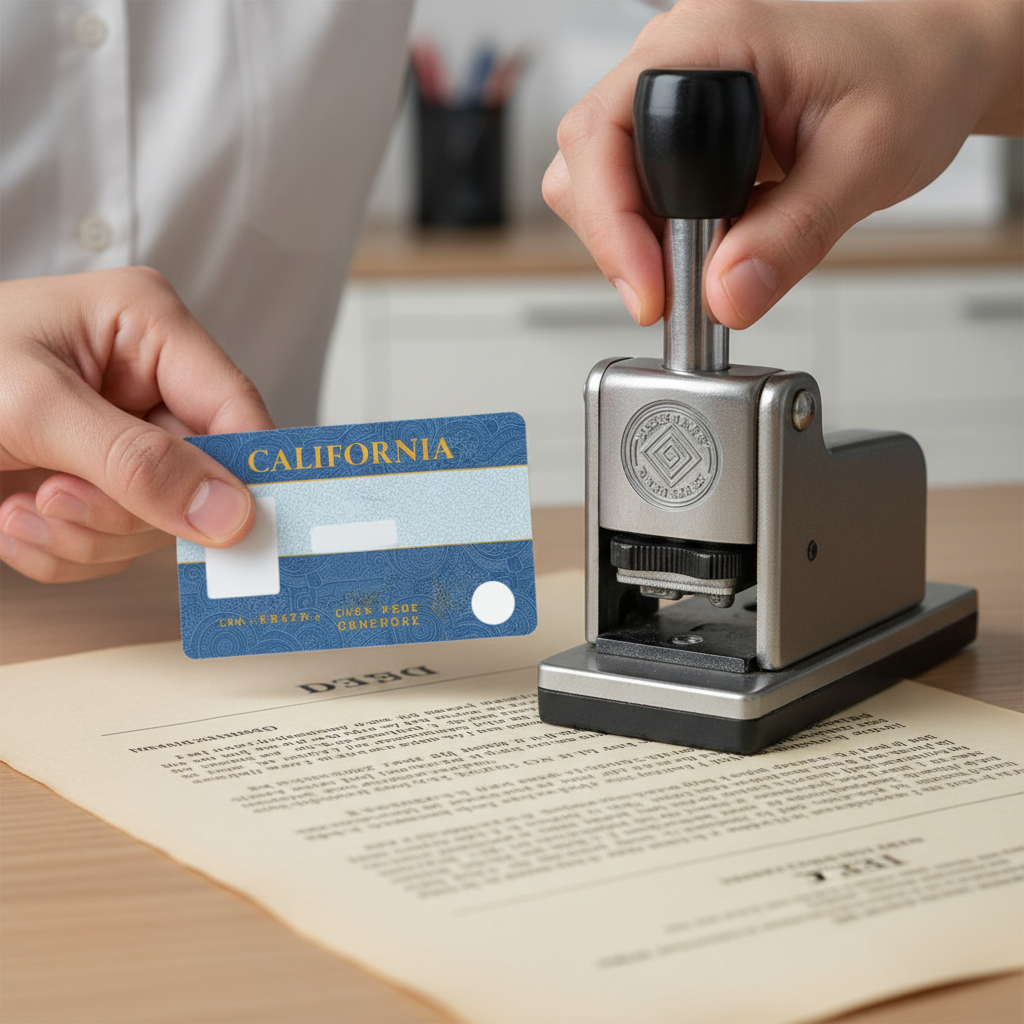
Why Proper Notarization Matters in California
Correct notarization ensures your deed records on the first attempt, preserves a clean chain of title, and reduces fraud. Errors—like wrong venue, missing seal, omitted thumbprint, or a name that doesn’t match ID—trigger county rejection, re-signing, and delays in transferring ownership.
- Recorder acceptance: County recorders rely on the notarial acknowledgment to accept and index deeds into the public record.
- Title insurance readiness: Clean notarization supports underwriting, future refinancing, or sale.
- Fraud reduction: California’s journal thumbprint rule for deeds and powers of attorney deters impersonation and improves traceability.
- Avoid re-signs: The most frequent rejection causes we see: incorrect venue, name/ID mismatch, missing seal, altered certificate wording, and documents with blanks.
- Los Angeles nuance: Many deeds submit with a PCOR; if it’s missing or incomplete, intake can stall even if the deed is perfect.
- Practical example: A Van Nuys homeowner updated title into a family trust. Because the acknowledgment matched California wording and the PCOR was included, the deed recorded the next business day—no callbacks.
Self-contained answer: California recorders require a properly completed acknowledgment to accept deeds. When the venue, date, signer’s name, notary signature, seal, and statutory wording align, the recorder can index the instrument. Missing or mismatched details lead to rejection and force parties to re-execute the deed.
How Grant Deed Notarization Works: Step-by-Step
Book a mobile notary, prepare valid ID, review the deed for blanks, sign in front of the notary, and receive the California acknowledgment with seal. The notary journals the act and captures a thumbprint for deeds. You then record the original deed—often with a PCOR—at the county recorder.
- Schedule a mobile visit: Pick your location—home, office, airport, hospital, or jail—so all grantors can appear in person.
- Gather identification: Bring a current government photo ID (driver’s license, passport, etc.). Names should meet California’s satisfactory evidence standard.
- Pre-signing check: Confirm the property address, legal description, Assessor’s Parcel Number (if used), granting clause, and parties are complete. No blanks.
- In-person signing: The grantor signs in blue or black ink in the notary’s presence. The notary observes and confirms acknowledgment.
- Certificate completion: The notary fills the California acknowledgment (Civil Code §1189) accurately—correct venue, date, name(s), signature, and seal.
- Journal entry + thumbprint: For deeds, the notary records the event and obtains a thumbprint (Gov. Code §8206).
- Recording step: Submit the original deed to the county recorder. Many Los Angeles filings require a PCOR submitted with the deed.
- Proof of recordation: Keep your recorder receipt and conformed copy for your files, lender, or title company.
- Helpful internal guide: For signings that involve an agent, see our overview on how to notarize power of attorney documents to validate authority before the appointment.
- Same-day logistics: If timing is tight, our same-day mobile notary guide explains how we coordinate urgent visits across Los Angeles.
Self-contained answer: After identity is confirmed, the grantor signs in the notary’s presence, the notary completes the California acknowledgment, and a thumbprint is recorded in the journal. The original deed—often with a PCOR—goes to the county recorder. A title company can frequently eRecord after a wet-ink notarization.
Types, Methods, and Approaches You’ll Actually Use
California grant deeds use acknowledgments, not jurats. Witnesses aren’t required. Paper, in-person signings remain the norm; title companies commonly eRecord the scanned original after notarization. Mobile appointments solve hospital, jail, or multi-party scheduling constraints.
- Acknowledgment vs. jurat: Deeds require acknowledgments; jurats involve oaths and are not used for deeds.
- Face-to-face requirement: Deeds demand in-person identity verification. Plan mobile visits when travel is hard.
- eRecording reality: Many title/escrow teams eRecord post-notarization. The notarization itself is still wet-ink.
- Witness lines on forms: California does not require witnesses for deeds; leave out-of-state witness lines blank unless the recorder instructs otherwise.
- Special settings: Hospital and jail notarizations are routine for us—coordinate access instructions, acceptable IDs, and any facility-specific procedures.
- Multisite coordination: When co-owners are in different places, we can stage sequential appointments and attach correctly referenced loose certificates as needed.
Self-contained answer: Expect an in-person, paper acknowledgment with no witnesses. After notarization, the original deed can be recorded, and title/escrow often eRecords. Mobile notarization is the practical approach for hospitals, jails, and tight timelines while maintaining California compliance.
Best Practices That Prevent Rejections
Match the name on ID to the deed, remove blanks, confirm venue, and use California’s exact acknowledgment text. Capture the journal thumbprint for deeds, use consistent ink, and keep attachments stapled to avoid certificate separation. These guardrails prevent most recorder rejections.
- Name match strategy: Use the ID name that satisfies California’s “satisfactory evidence” test (Civil Code §1185). If the deed lists a middle initial, ensure the ID reasonably supports it.
- No blanks policy: Legal description, parties, and property details must be filled before notarization.
- Venue accuracy: The county and state on the acknowledgment must reflect where the signing happens—not the property’s county.
- Certificate integrity: Use the statutory wording. Avoid cross-outs that change meaning. Attach a loose certificate if your form’s text is noncompliant.
- Journal + thumbprint: Mandatory for deeds and powers of attorney in California (Gov. Code §8206).
- PCOR readiness: Los Angeles-area recordings commonly require a PCOR at intake. Confirm the latest form with your title or recorder’s office.
- Language clarity: Documents in other languages may be notarized; the notarial certificate must remain in English with statutory text.
- Staple discipline: Keep any attached acknowledgment firmly stapled to the deed. Do not detach or re-staple after sealing.
- Multiple deeds session: When notarizing several deeds, seal and journal each instrument separately to avoid cross-mixing.
Self-contained answer: Prevent rejections by aligning names with ID, confirming the signing venue, using California’s acknowledgment text without edits, and recording a thumbprint. Bring a PCOR if your recorder requires it. Keep any loose certificates stapled to the deed to preserve attachment integrity.
Tools and Resources (California + Los Angeles)
Use the California Secretary of State’s acknowledgment wording, Los Angeles County Recorder intake guidance, and a title/escrow eRecording channel. A mobile notary adds compliant certificates, in-person ID checks, and journal protocols to keep your deed recordable.
- California Secretary of State: Model acknowledgment wording and notary reference materials.
- Los Angeles County Recorder: Deed presentation standards and PCOR instructions.
- Title/escrow partners: eRecording and conformed copy retrieval after notarization.
- Mobile notary advantage: We bring state-compliant certificates, verify ID, and handle journal/thumbprint requirements wherever you are.
- Related internal reads: If your deed is part of a trust update, see our estate plan notarization requirements. If the deed will be used abroad for any reason, our California apostille certification process explains next steps.
Self-contained answer: Rely on California’s official acknowledgment text and Los Angeles County’s intake rules, pair that with a mobile notary’s on-site ID checks and journal protocol, and use title/escrow eRecording. This toolkit moves you from signing to a recorded deed efficiently.
Case Studies and Real Los Angeles Scenarios
Mobile notarization fixes access, timing, and privacy hurdles. Across Los Angeles, we complete trust transfers at homes, urgent hospital signings, and inmate authorizations—each with proper ID verification, thumbprints, and clean acknowledgments—so deeds record on schedule.
- Van Nuys trust transfer: Kitchen-table signing; PCOR delivered with deed; recorded next business day.
- Sherman Oaks hospital: Bedside signing; nurse coordinated access; valid ID verified; thumbprint captured.
- Woodland Hills after-hours: Investor executed three deeds; separate certificates and journal entries avoided mix-ups.
- Downtown inmate visit: Facility cleared; acceptable ID verified; acknowledgment completed per statute.
- LAX meet-up: Out-of-state owner signed during a layover; deed overnighted to recorder via title.
- Encino co-owners: Split appointments across two addresses; properly referenced loose certificates consolidated.
- Reseda language assist: Deed in another language; English acknowledgment attached; signer fully understood purpose before acknowledgment.
- North Hills refinance follow-up: Title required confirmation of prior deed; clean acknowledgment accelerated underwriting.
- Tarzana trustee change: Trust certification notarized alongside deed; one cohesive file for title.
- Porter Ranch new construction: Developer formalized title placement; consistent venue and seals across multiple parcels.
- Studio City marital update: Spousal transfer; no witnesses; standard acknowledgment sufficed.
- Panorama City family gift: Parent-to-child transfer; tax advisor coordinated PCOR details.
- Granada Hills mail-away: Notarized deed sent to title for eRecording; conformed copy returned by email.
- Valley Glen estate plan: POA reviewed ahead of time; attorney-in-fact signed deed with authority documented.
- Canoga Park timing crunch: Same-day notarization enabled month-end recording window.
Self-contained answer: Whether at a home, hospital, jail, or airport, a mobile notary verifies identity, completes the California acknowledgment, and records a thumbprint for deeds. These steps keep Los Angeles transfers moving even under tight timelines or access constraints.
Need a Mobile Notary to Come to You?
Quickie Mobile Notary serves Los Angeles, Ventura, and Orange Counties—home, office, hospital, airport, or jail. We handle grant deeds daily, bring compliant certificates, and help you avoid recording headaches.
Local Tips
- Tip 1: If you’re near 15700 1/2 Vanowen St in Van Nuys, plan appointments outside rush hours on Vanowen St and Sepulveda Blvd for easier parking and faster signings.
- Tip 2: County offices get busier near month-end. Schedule your notarization a few days earlier so you can submit to the recorder without delays.
- Tip 3: Hospital or jail signing? Share unit or facility contacts ahead of time so we can confirm access, acceptable IDs, and bring any facility-required materials.
IMPORTANT: These tips reflect how we actually operate in the San Fernando Valley and Greater Los Angeles to keep your deed on track.
FAQ: Grant Deed Notarization in California
Grant deed notarization requires in-person acknowledgment, proper ID, and a complete document. Below are concise answers to common questions homeowners, trustees, and investors ask when preparing to sign and record in Los Angeles.
- How do I prove identity? Bring a current government photo ID. The name must satisfy California’s satisfactory evidence standard; hyphenations and middle initials shouldn’t create doubt. If names vary across documents, bring supporting IDs.
- Can someone else sign for the owner? Only with proper authority—e.g., an attorney-in-fact via power of attorney. The notary needs to see the original or a certified copy of the POA to confirm authority for the deed.
- Do I need witnesses? Not in California for deeds. The notary’s acknowledgment is sufficient for recording.
- Will the county accept an out-of-state deed? Often yes if the acknowledgment meets California standards and local intake rules. Many parties re-execute on California forms to reduce risk and speed intake.
- What happens after notarization? Record the original with the county recorder, generally with a PCOR. Title/escrow can help submit and confirm acceptance and return conformed copies.
Self-contained answer: Bring valid ID that matches the deed, sign in front of the notary, receive a California acknowledgment, and then record the original with your county recorder. Witnesses aren’t required. Title/escrow can often eRecord and confirm acceptance.
Comparison: Grant Deed vs. Quitclaim vs. Warranty
A grant deed conveys ownership with limited warranties of title; a quitclaim releases whatever interest the grantor has; general warranty deeds are uncommon in California. All require proper acknowledgment and journal entries for deeds to be recordable.
| Deed Type | What it Conveys | Typical Use in CA | Notary Certificate | Witnesses |
|---|---|---|---|---|
| Grant Deed | Title with limited warranties | Common for sales/transfers | California acknowledgment | Not required |
| Quitclaim Deed | Whatever interest exists, no warranties | Family transfers, title cleanup | California acknowledgment | Not required |
| Warranty Deed | Broad warranties of title | Uncommon in CA | California acknowledgment | Not required |
Self-contained answer: In California, both grant and quitclaim deeds rely on a notarized acknowledgment for recording, without witnesses. Choose grant deeds for typical transfers and quitclaims for releasing potential interests. Warranty deeds are rarely used in the state.
Related Topics We Can Help With
Grant deed signings often intersect with estate planning, agent authority, and international document use. Our team supports powers of attorney, trust certifications, and apostille facilitation when documents leave the United States.
- Estate plan notarization: When transferring a home into or out of a trust, we schedule all signers and trust documents together to minimize trips.
- Powers of attorney: If an agent must sign, we verify authority and ensure correct acknowledgment wording so title can rely on it. See our internal explainer on power of attorney notarization.
- Apostille facilitation: For notarized documents headed overseas, our California apostille certification guide outlines state, federal, and embassy pathways.
- Urgent mobility issues: Our same-day mobile notary resource shows how we stage hospital, homebound, or airport signings without stress.
Self-contained answer: Beyond deeds, we routinely notarize estate planning documents and powers of attorney, and we coordinate apostilles and embassy legalizations. If your deed touches these areas, we can handle them in one coordinated visit.
Key Takeaways and Next Steps
Bring valid ID, sign in person, use California’s acknowledgment wording, and plan for the PCOR at recording. A mobile notary eliminates travel friction and reduces rejection risk so your transfer posts to county records without drama.
- Primary actions: Prepare ID, review the deed for blanks, and coordinate your PCOR.
- Compliance essentials: California acknowledgment, journal entry, and thumbprint for deeds.
- Logistics: Schedule a mobile notarization at home, work, hospital, airport, or jail across Los Angeles.
- Recorder handoff: Record the original deed; title can often eRecord and return conformed copies.
We’re ready when you are—serving Van Nuys and Greater Los Angeles with privacy-first mobile notarizations that meet California’s requirements on the first try.
